Monday, May 27, 2013

Wake (Boss Baddie, 2010)

A decade ago I remember having a conversation about how games were getting so expensive to produce that studios couldn't take chances any more, and had to make sure their games were in "proven genres". Proven genre of course was an industry term for just copying whatever game was the best selling at the time. There wasn't a lot of originality in the market back then.

Fast forward ten years and the industry is a much different place. With every console offering downloadable content, mobile game sales on the rise, and PC services such as Steam offering discoverability and profit alongside the top high profile titles, this is a golden age for indie games. Sure, they might not have the scope and polish of the top AAA titles, but many of them more than make up for it with originality and imagination. One such game is Boss Baddie's retro styled Wake.


Wake is part of a growing trend of retro styled games, games that intentionally mimic the visual look of older generations. These days they are all over the place, but back in 2010, it was still a novel and daring approach. Wake, for the most part, imitates the look of SNES games of the early to mid 90s. I say for the most part because while its pixelated sprites and environments certainly hold that 16-bit charm, Wake tops it with a generous helping of modern video stylings such as particle generators and lighting effects.


Wake takes place on a large ship that is sinking in the ocean. You start the game by awakening at the bottom of the ship's hull, and must race the rising water to escape. The entire world slowly rotates as the ship rocks back and forth in the sea. The water level continually rises throughout the game revealing some imaginative mechanics. Certain objects throughout the ship are buoyant, and will change position as the rooms flood. Some paths are only accessible before the water reaches the area, while others are blocked until the entrances are submerged.


The gameplay of Wake at first resembles the Metroidvania genre. It's a 2D side view non-linear platform adventure game where you explore your surroundings across an intricate map of interconnected rooms and collect the tools you'll need to get to your final destination. It's the pacing that is the source of Wake's originality. While most Metroidvania titles take 10+ hours to complete, Wake's simple tale of escaping a sinking ship can be breezed through in about half an hour.


In Wake however, winning is the easy part. If you just escape from the ship and then move on, you haven't really experienced the game. There's a large ship to explore, with many secrets to uncover. The game doesn't force you into every nook and cranny as would be the case in most games of the genre, but instead rewards you for finding your way into these areas on your own. The game is full of collectibles that all add to your score, which is submitted to an online high score table. Then there is the question of why the ship is sinking in the first place. Wake isn't meant to be a game that you play once, it's meant to be played many times and experienced different ways. A much different approach than the typical linear narrative presented by most games.


As a retro console inspired game, I was delighted to see that it had gamepad support already implemented. I've read that some people find the keyboard controls to be a pain, but it handled great with an XBox 360 gamepad. And really, every PC gamer should own one of these, or at least a 3rd party knock off. Surprisingly, this is the first 2D side scrolling platformer I've played in which the left analog stick offered better control than the Dpad (both are simultaneously supported), especially while swimming, which you'll be doing a good amount of throughout the game.


The music in Wake offers a combination of electronic loops and lonely haunting piano. It's the type of track you could leave on in the background all day when you're feeling down. Visually, the game's unique look made me think that if I could take this back in time 20 years, it would be the greatest looking SNES game ever. I only wish it supported higher resolutions for full screen play, it tended to have a blurriness on my 1080p monitor.


I'll say that this is definitely not a game for everybody, but at only half an hour for a full playthrough, I think it's a game that anybody with even a fleeting interest in the genre should try at least once. As with most indie games, it doesn't cost very much, and it's good to support imaginative indie developers, for the sake of the future of gaming in general. The big irony I found in Wake, is that for a studio named Boss Baddie, there were no epic boss battles. Oh well, maybe next time.

Monday, May 20, 2013

Portal (Valve, 2007)


There's an irony in gaming. Ask most gamers what they enjoy most about gaming and the word freedom comes up quite often. Games give you a sense of freedom to be something you can't be in real life, and do something you can't do in real life. It's everything that reading enthusiasts say about the magic of reading, but in a much more interactive format that appeals to more of your senses. Now if you ask one of the anti-gaming doomsayers what they like least about gaming, they will often claim that it makes gamers more rebellious,  more counter-culture, more anti-establishment.

The irony in all of this is that when you really break it down, video games are mostly about following the rules, doing what you're told, and conforming to expectations. When you're playing GTA and running from the cops while fleeing the scene of a bank robbery, you're not doing it because you're breaking the rule that says don't rob banks, you're doing it because in the GTA world, getting the bank robbers away from the cops is what you've been told to do, what you're supposed to do, it's the rules that you are following. Portal is a game that at least creates the illusion of breaking this. In Portal, following the rules and doing what you're told can have detrimental results.


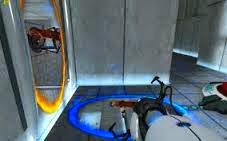
To start with, Portal plays like a long tutorial divided into 19 sections of increasing length and complexity. You start off by learning the basic controls, typical FPS movement, and then move on to the unique mechanics of the portals and how they bend reality. It's pretty disorienting at first, but after a few minutes you start to wrap your brain around it and it starts to feel more natural. You're lead through all of these by the disembodied voice of a helpful A.I. that monitors your progress through security cameras placed throughout the areas. Once you've gotten the basics down, you are given a portal gun so you can create your own portals, and this is where the puzzles start to get more complex.


Yes, even though it's a spin off of the Half Life series, and has that same FPS look and feel, Portal is a puzzle game. It's a game that forces you to think, and rewards creativity over twitch reflexes. There are enemies in the game, in the form of automated turret gun robots, but unlike traditional first person shooters, you can't attack these turrets directly, and instead have to find interesting ways of disabling them such as creating a portal below them to make them fall, or above them to drop something onto them. Even in combat, everything in Portal is a puzzle.


I mentioned that the game is arranged like a tutorial, and for the most part it is. Each level introduces something new, and gives you clear instructions on what is expected of you, with the simple promise that you will be presented with cake at the end of the last challenge. At certain points however, all of this starts to break down. The clean white automated testing environment holds dark secrets. Every so often, a malfunctioning door or other piece of equipment gives you a fleeting glimpse into a different world. Others have gone through these same tests before you, and some have escaped only to live in the walls and corridors between the levels. Although you never see these people, you are presented with their mad writings they left behind as they were driven further and further into insanity. Throughout all of these chaotic scribblings, there is one phrase that stands out above all others: "The cake is a lie"


This is where the genius of Portal really shines through. Not in the innovative use of technology and gameplay presented by the portal gun, but in the thematic presentation that everything you've been told is a lie. The clean orderly world where you do what you're told unquestioningly with the promise of belated rewards is just a front to hold your mind captive for the benefit of the unseen elite behind the scenes, while this dirty underground world of refugees and outcasts is the true reality that you are being blinded to, yet you can't help but realize what it is that you must do. You must escape.


Now of course, it's just a game, and neither world is actually real, but as you transition mentally from playing the friendly tutorial game to the dark and dangerous game of escaping from within the confines of this advanced complex of a sinister organization, it feels like an awakening. It causes you to question the trappings of your own life and wonder what is real, and what is just imaginary cake.


A lot of this power comes from the stark contrast in the presentation of each of these worlds. The clean tutorial sections, while realistically textured, shaded, and rendered, use very few polygons. Everything is very simple geometry with bright friendly textures. The behind the scenes world uses a much more realistic visual style. Things are dirty, rusty, and worn out. Nothing looks safe or inviting, and you may even question your decision of ignoring the warnings of the friendly A.I. voice that constantly tells you that you are going the wrong way and you should come back before all of the cake is gone.


Portal isn't a very long game, and if you have a free evening you might even complete it in a single sitting. It presents you with additional challenge modes at the end to enhance the replay value, but it's the main story that makes it truly shine as a modern classic. If you haven't played it yet, you should. Even if you don't normally like puzzle games, it's worth picking up a copy during the next Steam sale just to experience what everybody else is talking about.

Monday, May 13, 2013

The Witcher: Enhanced Edition (CD Projekt RED, 2007/2008)

How long is a game? How long should a game be? These are questions that get tossed around on message boards from time to time. Some people refuse to play a game that takes more than 10 hours, while others feel ripped off if a game lasts for less than 20. The earliest arcade games were only meant to be played for a few minutes at a time. The longest games tend to be of the Role Playing Game genre. If you've been keeping up with my posts lately, you might have noticed that my last three reviews, Softick Freecell, Bad Dudes Vs. DragonNinja, and Devil's Crush, were all games that don't take very long to play through. Have I been slacking off? Nope, I just wanted to keep the new reviews flowing as I spent several weeks finally playing through The Witcher: Enhanced Edition.


There are many types of RPGs. Because of this, fans of certain types sometimes don't consider other types to be role playing games at all. The sandbox RPGs are quite different in feel from the JRPGs, which are in turn quite different from the Action RPGs. Some people prefer well defined characters and engaging stories, while others prefer completely customizable characters and just want to soak in the atmosphere of the world's happenings, without having a specific narrative forced at them.


As far as RPGs go, The Witcher is definitely on the more linear side of the bell curve. Rather than spending the first ten minutes selecting a race and class or deciding what eyebrow color and nose shape you want, you start the game right away as Geralt of Rivia. Geralt is a witcher, a member of a clan of professional monster slayers, genetically mutated to be the best at what they do. The game opens with the witcher's base being attacked by a mysterious gang known as Salamandra. The rest of the game is spent mostly tracking down this organization, but also taking part in a growing conflict between the human and non-human residents of the city of Vizima.


In standard RPG style, the game consists of quests. There are the main quests which take you through the game's story, side quests you receive by talking to random NPCs in need of assistance, contract quests picked up at various job boards throughout the game, and skill quests encouraging you to improve you abilities at gambling or fist fighting. Unlike traditional RPG quest chains, it's not always about kill X of this, or collect X of this, or deliver this to that guy. Ok, a lot of them are still like that. Others, however, are more introspective in nature.


Geralt is a recently resurrected amnesiac, so one of your quests is simply to discover more about your identity. This quests lasts throughout the game, and is advanced with various choices large and small that you make throughout the game. Another quest is to investigate the disappearance of a fellow witcher. This quest is slowly advanced as you discover clues throughout your journey, and it has various outcomes depending on how it is pursued. Many of the quests overlap, and the same course of action can simultaneously advance both of them. It's the type of thing that could easily turn into a tangled mess, but luckily it was implemented beautifully, so it never seems to get in the way. After advancing any quests, text prompts fade into the bottom of the screen one at a time showing which quest was advanced with a quick synopsis of what the next step in that quest chain is. On top of that, any one quest at a time can be tracked with markers in both your map view, and the mini-map in your main UI.


As with most games of the genre, The Witcher relies heavily on its storytelling. It's not the expected "stop the bad guy and save the world" type of story either. While there is an obvious set of bad guys you are after, the rest of the characters are largely ambiguous. You are cast into the middle of a conflict in which both sides are entirely justified in their actions, and yet equally justified in seeing the other as evil. The game constantly puts you into moral dilemma situations, with your choice of action in each helping to establish Geralt's missing identity. While there are plenty of generic NPCs wandering around the game with names like Peasant, Guard, or Nurse, the NPCs that you actually interact with all have well rounded personalities and interesting back stories. I spent a good amount of time in the game simply asking them about their lives and getting their various perspectives on the events of the world. I've heard that the game is based on a series of books written by Andrzej Sapkowski. I haven't read those books yet myself, so I'm not sure if the game closely follows the stories of the series or simply exists in the same world. Either way, the world feels alive and lived in, which I imagine owes a great debt to the book series.


An interesting aspect of the game is how the story can branch off in so many different directions depending on your choices throughout. There are the obvious options such as siding with one army against another, or choosing between two redheaded romantic interests, but there are other more subtle aspects such as the guest you invite to a dinner party, or even how you choose to answer certain questions in the middle of a conversation. The game likes to sneak in these choice moments when you're not expecting them so you'll make honest decisions instead of trying to game the system for the ending you want to see.  It's the type of system that could lead to some great replay value if I was the type who had time to play through a game this long more than once. I've got too many other games to get to for that. First world problems, I know.


As with Mass Effect and God of War, The Witcher also deals with more adult situations. In addition to being a resurrected amnesiac mutant monster slayer, Geralt is also a womanizer. Or rather, Geralt has the potential to be a womanizer depending on the choices you make throughout the game. Several of the women you meet over the coarse of your adventure can be, for lack of a better word, bedded. If you're expecting a porn simulator, you'll be disappointed. These encounters usually consist of a playful exchange of double entendres followed by a fade to black, then the blurry out of focus Geralt is getting it on montage in the background as you are awarded a collectible card featuring a painting of the character in a provocative pose. Sure, it's not the classiest thing in the world, but it's far from the plague of corruption some conservative fundamentalist doomsayers would have you believe. Womanizer characters have existed in books, movies, and TV shows long enough to have them cross over to video games. It actually reminded me a lot of the intimate encounter scenes in the classic NES game Golgo 13: Top Secret Episode. Yes, sex has existed in video games for decades. As with other forms of entertainment media, not every release is designed for children.


In the genre of RPG video games, combat is undoubtedly one of the least consistent features. It can be turn based as in the classic Final Fantasy and Dragon Quest games, smooth and flowing as in Fable and Kingdoms of Amalur: Reckoning, or it can be deliberate and just a little bit awkward as in the Risen and Elder Scrolls games. Yes, I know that speaking ill of the Elder Scrolls series borderlines on blasphemy, but when people explain what they love about those games, combat is never at the top of the list. Digressions aside however, combat in The Witcher uses a much different mechanic than I'd experienced before. To start with, there are three views available for playing. There's a Diablo style top down view, a closer up top down view, and then there is a more standard over the shoulder view, which as far as I can tell from youtube and image searches is the only view that anybody playing this game has ever actually used.


The Witcher's combat mechanic was developed to work equally well in any of the three views. it consists of placing the cursor (the aiming reticle in the over the shoulder view) on an enemy, and clicking when you see a sword icon. Once you've started the attack, the icon changes, and if you click again during this you will interrupt your attack. At the end of the attack, the cursor will quickly light up, and clicking again on the enemy during this will chain your next attack as a combo of the previous, increasing the amount of damage being dealt. These attacks are performed with one of two types of weapons: Steal weapons, strong against other warriors, but weak against monsters, or silver weapons, strong against monsters, but weak against other warriors. There are also three combat styles to choose between, a strong yet slow attack that can do more damage against armored foes, but is useless against the more nimble enemies, a fast yet weaker attack that can hit anybody, and a group attack that while not as strong as as the other two, can damage multiple enemies around you as you swing your sword in wide circling arcs with each attack. On top of this, you also get magic that can be cast by right clicking.  You can launch fireballs to ignite your enemies, knock them to the ground to possibly disarm them, or even set traps on the ground to lure them into. As would be expected in a game like this, each of the six attack/weapon combinations and each magic type has its own page of skills that can be upgraded as you level up your character.


Potions can also be used to enhance your fighting abilities. The game has a rather elaborate alchemy system for creating potions from recipes you find, and I have to admit, I never actually used it. I was able to collect enough useful potions to get me through the tougher boss fights in the game, and the rest of the time I simply chose my battles carefully so I never got overwhelmed by too many enemies at once, or at least ran away whenever I was. Having extra potions would certainly have made the game easier, but since I was never in a situation where I absolutely had to figure out the alchemy system, I never bothered to. I know that some RPG players really get into the crafting systems of these games, but I've never personally been one of them.
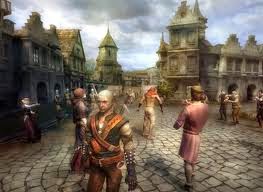

Visually, the game has a nice look to it. It might look a little dated now, especially when compared to the Witcher II screenshots I've seen, but it still looked nice. The world is smaller than what most RPG have to offer, so in trade it is much more detailed than I was expecting. Even in the swamp forest, things still managed to look unique. The city of Vizima had a charm to it, and after a few weeks I started to feel like I was actually a resident as I cut through alleys and dashed around through the streets. The character models, while still on the other side of the uncanny valley, all had a consistent look to them so you could after a while get used to this simply being how people look in this world. Some of the character models do get reused quite often though, so just because you think you see the person you met in the pub earlier, it doesn't mean that it's the same person.


A big part of getting lost in these worlds is in how the story is presented to you, and a big part of that is in the dialog. In The Witcher, every line of dialog is spoken by a capable voice actor, which helps with the immersion factor. The only weird part was that the accents were inconsistent. Most of the cast has british accents, pretty standard for the fantasy genre, some have scottish accents, and still others have american accents. Compounding the situation is that many of these characters are supposed to be local to this town, having spent their entire lives here, and possibly many generations of their family. It just seems weird that they would speak so differently from each other. Musically the game sounds amazing. The combination of orchestral and renaissance folk music captures the mood of this fantasy world perfectly. Don't be surprised if you find yourself humming along with the melodies from time to time.


I played through the Enhanced Edition of The Witcher because that's what's available these days. I've never played through the original non-enhanced version, so I can't really say what exactly was enhanced, but I can say that this game played great. For a game of this size, everything held together and never felt buggy. If you're the type that doesn't mind the time investment required by a long game, then this just might be one worth checking out.

Monday, May 6, 2013

Devil's Crush (NAXAT Soft, 1990)

In my last review on Bad Dudes Vs. DragonNinja I waxed nostalgic on the days of arcades. These days, there are many who don't even realize that arcades have actually been around longer than the existence of the video game industry. What could people possibly do in an arcade without video games? Well, once upon a time, arcades provided entertainment through mechanical means, rather than digital. I am of course referring to pinball. Pinball machines were once a mainstay of pop culture. Almost every bar or nightclub would have at least one in a corner somewhere.

These days most people only experience pinball through their digital recreations. Video games have long tried to capture the essence of the pinball experience in digital form. Most of these try to either recreate actual pinball machines, or create new designs that at least could possibly exist in the physical world if anybody really wanted to build them. But in the world of video games where anything is possible, why limit yourself to the constraints of reality? Why not try to push things a bit farther and see what happens? Well, a couple of decades ago, a company called NAXAT Soft decided to do just that.


Devil's Crush for the TurboGrafx-16 (or PC Engine if you're on the other side of the pond) was the second of a handful of imaginative pinball games made by NAXAT back in the late 80s and early 90s. The first of the series, Alien Crush, actually got a modern remake on the Wii a few years back. There was also a port of Devil's Crush for the Sega Genesis (or Mega Drive, the pond thing again) renamed Dragon's Fury.


What makes these games different from other pinball games is that the tables are filled with living crawling creatures that you battle with the pinball. This entry into the series has an occult theme, so the table is populated with monsters, demons, dragons, hooded monks, sword wielding knights, and other such beings. They don't just hang around in one place either, they wander around the board as would be expected from a standard video game enemy. Striking one of these creatures will usually cause the ball to bounce off as if striking a standard pinball machine bumper, and will destroy or damage whatever was struck. Many of them will respawn once you've destroyed the entire group, allowing the game to continue indefinitely until you eventually lose. The larger creatures that require multiple hits to destroy will look different after each hit, showing more and more damage, to both allow you to track your damage, and encourage you to keep at it. One of the largest is a face of a woman in an armored helmet, who transitions into the face of a dragon after enough shots.


The main table consists of three interconnected areas, each about the size of the screen. As the ball travels up and down the table, the screen will smoothly scroll to follow it. Each of these areas has its own set of paddles. This allows you to play in different areas at different times and changes the feel of the table depending on which set you are currently in. If the ball slips past the paddles it moves down to the next lower area, and the ball is only lost when it slips past the bottom-most set. As you can imagine, trying to keep the ball at the top of the table is a good strategy to adopt early, and learning how best to get the ball up to higher areas is one of the more important skills to develop in this game.


In addition to the main table, there are also sub tables that act as bonus areas. If you manage to get the ball into the right spot at the right time, you are taken to an entirely new single screen area with what feels like a boss battle. These screens generally have one or two larger enemies to do battle with. You'll stay in this area either until the enemies have been defeated, or until you miss the ball and it rolls off the bottom of the screen. Either way, the ball is then returned to the same spot on the main table, and the game continues on where you left off. These screens are always exciting, and offer a great change of scenery seldom offered in a pinball game. It's yet another example of how a pinball machine in a video game shouldn't have to follow the same rules that the real machines do.


Without a doubt, the single most important aspect of a pinball video game is the physics emulation. It's something that even modern games can get still wrong. When I first played Devil's Crush, I was worried about how well it was going to handle this on 1990 technology. Somehow they managed to pull it off wonderfully. Those pixelated sprites zoom around the 2D table with all the weight and friction you'd expect. You can even start a game in slow mode to have a little extra reaction time, without sacrificing the physics reactions.


Graphically, Devil's Crush is what I'd imagine a 16-bit Gauntlet release might have looked like. It's dark and creepy and just crawling with evil monsters of all sizes. The creatures themselves remind me a lot of the Doom series. The sound is mostly your typical pinball sounds with the occasional monster noise. A large skull near the bottom of the table lets out a menacing laugh every time you lose, making it all the more satisfying each time you manage to nail it with a well aimed shot. There's not a lot of variety in the music, but the few tracks they have are great! The main song that plays while in game is the closest FM music can get to gothic progressive metal. Imagine a synthesized blend of Nightwish and Symphony X. Somewhere on the net there has to be a recording of some random band covering it, but I haven't gotten around to looking for it yet.


I had a TurboGrafx-16 back when they were still the new thing, but I never played Devil's Crush on it. Actually I never heard of it until I got a Wii and was researching virtual console games. It was the second virtual console game I downloaded, right after Super Mario Bros. 3, and I've enjoyed it ever since. If you're looking for a realistic pinball simulation, this isn't it. But, if you want to see what pinball could be without the constraints of reality, Devil's Crush is an addictive place to start.

Monday, April 29, 2013

Bad Dudes Vs. DragonNinja (Data East, 1988)

Remember arcades? Sure, they're still around in one form or another, but not the way they used to be. For decades, arcades were magical worlds that offered brief glimpses into the future. Imagine being able to go to your local mall and pay a quarter to play on a PS5 for a few minutes. Back when home gaming consoles were still that new thing the kids were into, arcade machines could offer technological feats that the home market usually wouldn't be able to match for a generation or two.

During the late 80s and early 90s, one of the largest genres was the side scrolling beat 'em up. Most of them closely followed the formula established by Double Dragon in 1987. Teenage Mutant Ninja Turtles, Golden Axe, several Marvel super hero franchises, and even The Simpsons had games of the style. However, a few tried to go in their own directions. One of those games was Bad Dudes Vs. DragonNinja.


When Bad Dudes first came out, I mostly remember it as being "that fighting game that's not Double Dragon". While it never really got out of Double Dragon's shadow in terms of success or popularity, it still managed to offer a fun arcade experience that was all its own. Sure, it was obviously influenced by Double Dragon which came out a year before it, but also by the co-op shooter platformers of the time such as Konami's Contra and Rush 'n Attack before it. While Double Dragon and most of the arcade beat 'em ups that came after were played in a pseudo 3D perspective, Bad Dudes had a more traditional strict side view. What it lost in ground maneuverability, it made up for with multi-level platforming action.


The levels generally offer two platforms to play on which can be jumped between at any point, similar to Sega's classic Shinobi. These platforms are often blocked or broken, forcing the player to utilize both in order to effectively navigate through the areas. Breaking up the constant scrolling to the right, the screen sometimes shifts up or down causing the upper or lower platform to become the other. This allows levels to travel up and down hills, follow elevators between floors of buildings, and other tricks that while mundane by today's standards, were genre innovations at the time.


For added variety, Bad Dudes also has two vehicle levels. The first has you fighting on top of semi trailers as they speed down the highway, which playing it again after so many years reminded me a lot of the freeway scene it the second Matrix movie. I don't have any reason to think that the Wachowski brothers were directly inspired by Bad Dudes, but who knows? The second has you fighting on top of a moving train, paying tribute to the classic scenes in so many westerns and spy movies. Vehicle levels would later become a standard element of games in the beat 'em up genre, inspiring several memorable moments, such as the rocket skateboard level in the Teenage Mutant Ninja Turtles arcade game.


You can't review a beat 'em up game without going into detail about the combat. Bad Dudes actually has a much different combat system than most other games of the genre. Most of the enemies you'll come across can be defeated with a single hit, which is fortunate because you'll be fighting off a lot of them! It might not be the most realistic depiction of hand to hand combat in gaming, even for its time, but fending off dozens of foes at a time makes for a great fast paced arcade experience and certainly conveys a sense of power onto the player. You feel like these really are bad dudes. The controls are also less typical for the genre, with only two buttons, jump and attack, instead of the more common three button configuration with separate punch and kick buttons. Even with the somewhat limited input, the game is very context sensitive and manages to pick the most appropriate attack for the situation. There is actually an impressive number of attack moves hiding beneath the surface of the game. One thing it does lack however is any sort of block or dodge ability, but this can mostly be overcome by jumping to the other platform to avoid an enemy's attack. This move becomes increasingly useful in the many boss battles.


As powerful as the standard enemies make you feel as you punch and kick your way through the mobs of fodder, the boss fights manage to keep you humble as they keep you reaching for the next quarter. The bosses have some pretty clever designs, each one requiring a different technique to defeat. Trying to simply hack your way through them will cost you several lives and continues. My favorite was the green ninja who duplicated himself. You have to take down each of his clones before you are able to land a few punches and kicks on him, only to have him start the multiplying process all over again. Karnov, the fire breathing russian star of his own arcade classic, makes a cameo as the boss of level 1. On the NES port, one of the later bosses strongly resembles the lead character from Bionic Commando, leading me to think for years that this was another cameo. However, in the arcade version it is clear that it's just a guy swinging a long chain above his head.


I'll admit that growing up I played the NES port much more often than the actual arcade machine. Because of that, I always think of the NES sprites when remembering this game. Playing the arcade version again, I was surprised by the quality of the graphics. It's not the best looking game, but for the era it looks good. The characters are large and detailed, and the environments, while not the most inspired ever, always look like they fit the style well. The UI graphics are a letdown though. The health meter bars are blocky and look like something from an 8-bit console, and the extra lives icons could pass for Atari 2600 characters. Luckily, the constant onslaught of action keeps your eyes from wandering down to the UI for more than quick glances.


Like many action games of the late 80's, the story doesn't make much sense. The United States is in the middle of a ninja attack epidemic, culminating in the kidnapping of president Ronnie, who looks like a blond Ronald Reagan. How does the government respond to this crisis? Do they send in the Secret Service? The Marines? The FBI? The Boy Scouts? Nope, taking a page from Escape from New York, they send a pair of unarmed street fighters to punch and kick their way through the ninja forces and rescue the commander and chief of the nation with the world's largest military. What is your reward for pulling off this historical and monumental achievement? You get to go for burgers with the president while hundreds of Secret Service agents cheer. Where were these guys earlier?


The sound in Bad Dudes is a real treat. The music is on par with some of the best of the FM synth era, providing energetic tunes that keep your adrenalin up without distracting from the gameplay. But, the big winning feature has to be the digital audio sound effects. It's hard now to remember a time when sound effects in games were programmed instead of recorded, but before the SNES, that was the standard. This game uses digital recordings for the various sounds, and even a few short lines of dialog, including the "I'm bad!" sample that plays at the end of each stage to celebrate your victory over the level's boss.


Is Bad Dudes Vs. DragonNinja the greatest arcade game ever? No. Was it the best arcade game of its time? I'll have to say no again. But, it's hard to deny that it's an extremely entertaining game that will test your reflexes for a good half hour or so, and as a two player co-op title, it's a great game to load up while hanging out with a friend. The real question is, "Are you a bad enough dude?"

Friday, April 26, 2013

Freecell Solitaire (Softick, 2009)

Pop quiz! What is the most popular video game of all time? It's not Call of Duty, or World of Warcraft, or anything with Mario in it. The most popular video game in the world is Solitaire. Almost everybody plays it. It's simple, it's addicting, and it comes pre-installed on most computers. For millions, it's the first thing to click on when waiting for a large download, or just when the boss isn't looking at work.

When I first got my Gateway 486 running Windows 3.1 back in the early 90s, Microsoft's version of Klondike Solitaire was waiting for me and sucked away many hours of my time. When I got my Windows 95 system, it had a new Solitaire game to offer, a game called FreeCell. I quickly became a convert from Klondike to FreeCell and never looked back. Almost a decade ago when I had an early Sidekick II smartphone, I downloaded my first mobile FreeCell game from its app store. When I made the switch to Windows Mobile, the first thing I downloaded was a FreeCell game, and again when I jumped on the Android bandwagon. I've spent a lot of time playing a lot of video games over the years, but I believe I've spent more hours playing that Android FreeCell game than I have any other.


Before getting into my review of this particular App, I should start out by giving an overview of the game itself for those of you less familiar with it.


Unlike most forms of Solitaire, a game of FreeCell begins with every card on the table face up. The initial shuffle and deal to start the hand is the only random element to the game. There is no guessing what might come next, no hoping for the card you need, only thinking and strategizing. FreeCell is a puzzle. If you have the time, it is entirely possible to deal a game, and then just stare at it until you've figured out the entire solution. I've never done that myself, but I often think through several moves before touching the first card.


What gives FreeCell its name is that rather than moving entire stacks of cards at a time as in most Solitaire variations, you can only move a single card per turn. Four free cells are available to hold any card you'd like to put there, but can hold only one card each. Keeping these cells from filling up is the key to success. Moving one card at a time is a tedious process, so most electronic releases allow you to move multiple cards at once, provided that you have enough free places to accommodate the move if you were to do it one at a time. Some games have you click on the highest card in the stack that you want to move, some have you click the stack multiple times to select multiple cards to move.

In order to be user friendly on a small phone screen, Softick's Freecell has an intuitive system to just know what it is you want to do. You drag the top card off of a stack, and the maximum amount of cards that can be moved will highlight, along with any stacks that any of them can be placed on. After dragging to one of these other stacks, the game works out how to make it work and you don't have to think about it. The dragging is fast and responsive and feels incredibly fluid as you drag the virtual cards around the screen, even on older devices such as the first generation Motorola Droid that I used to own.


Winning a hand presents the expected animation flourishes which can be skipped simply by tapping the screen if you'd rather just get on to the next deal. Several gameplay options are available including keeping score and timing your game. I usually leave these disabled, as I play for the puzzle, not the score. There are also several aesthetic options controlling the style of the cards, the background, and what animations the cards perform. It even allows custom backgrounds based on images on your phone, or even can use your phone's camera to make new backgrounds.

The best part about this app is that it saves the card layout as you go. Even if your phone locks up and you have to take the battery out to reset it, the next time you launch the game you'll find the cards sitting exactly where you left them. There's no need to go into a save menu or an options screen, like so much else in the game, Softick made it thoughtlessly simple and intuitive.

Overall, there's not much to this game, but it's not a game that needs a lot. As I mentioned earlier, out of all of the games I've ever played, this is the game I've spent the most time playing. It's been my first choice for years for when I've got a minute or two to spare, and out of all of the FreeCell games I've tried, this one just feels the best. It's a free game too, so if you've got an android device and like solitaire, it's worth looking up.

Monday, April 15, 2013

Beyond Good & Evil (Ubisoft, 2003)

After playing through Ico, I was curious about other games that might have slipped under my radar. I remember a year or so ago when I was eagerly awaiting the release of Darksiders II, I went online looking for games that were also heavily influenced by The Legend of Zelda. Most of them were games I already knew about: Okami, Landstalker, Darksiders, Neutopia, StarTropics, great original games often brushed aside as "Zelda Clones". But then there was Beyond Good & Evil. Somehow I had never heard of this one. I added it to my wishlists on both Steam and GoG, and patiently waited for it to go on sale. At some point it finally did, and I happily purchased it, yet it sat in my ever growing list of games to play for a while. After finishing Ico, it was finally time to give it a spin.


I should start out by clarifying that even though Beyond Good & Evil is clearly influenced by Ocarina of Time and Wind Waker, it is far from a standard Zelda clone. For the most part it plays more like a traditional RPG than any of the Zelda games, with a strong focus on speaking to various NPCs and following clues rather than the standard "go to X dungeons and collect all of the magic foo!" quests. On the other hand, the game is much more linear than most RPGs, and the gameplay is more action oriented, so it exists in its own space somewhere in the middle. This somewhere in the middle style might have been what led to disappointing sales when Beyond Good & Evil first launched. It never really found its audience until years later when people started to regard it as a classic. Recently it has been re-released in an enhanced HD version. I didn't have that one, so instead I played through the original 2003 version.


The gameplay overall incorporates many different elements from a variety of genres. You get stealth missions, vehicle races, puzzle solving, aerial combat, and even some platforming. The game is a jack of all trades, and while it doesn't quite master any of them, it manages to pull most of them off surprisingly well. The mechanics do feel a little awkward at times, and there are several signs of lack of polish. The camera sometimes clips through objects. Transitions between regions often show your hovercraft crashing into walls. NPC companions tend to get in your way more than they should. Saving your progress involves sitting through slightly excessive animation sequences. This game came out a decade ago, and really tried to reach beyond what games were doing at the time. Somebody at Ubisoft must have been feeling extremely ambitious when this game was designed. Luckily, what the game got right more than makes up for what the game got wrong.


Similar to Zelda/Metroid style games, Beyond Good & Evil is set in a somewhat open world, with most sections blocked off until certain keys, items, or vehicle upgrades are acquired. The game is set on a mostly water based sci-fi world, and an upgradable hovercraft is used to travel between the various islands. These upgrades are all purchased at the same shop using pearls that you collect throughout the game. This makes it feel a bit more arbitrary and less like a natural progression than what you get in most of these types of games where you find the objects along the way, but it serves its purpose well enough, and actually makes a lot more sense from a story perspective.


The game is broken down into a handful of large dungeon-like areas, with side quests and RPG style gameplay in between. It's not uncommon to have an action or combat sequence in the middle of an otherwise peaceful and safe area. Sometimes, progression on the main quest is only possible by purposely failing a side quest in interesting ways. An element that I found refreshingly original about the game is that even though there is plenty of combat and item collecting throughout the game, the main point of each mission isn't to collect ancient relics or destroy the bad guys. You're main mission is to photograph important evidence. You play as a photo journalist turned resistance fighter trying to expose a conspiracy. This doesn't mean that there aren't boss fights however, but your mission is completed when you get the right photos, and the boss fights are simply story elements that stand between you and your destinations.


The side quests in the game are varied and plentiful. There are heavily fortified bases to sneak through to collect better equipment or other items, hovercraft races to earn extra pearls, caves to explore, even an air hockey style game you can play in the bar. One of the more interesting side quests, and your primary source of income early in the game, is photographing the planet's wildlife. At the beginning of the game you are tasked with photographing every species of creature in the game, NPCs, enemies, bosses, or even just random aesthetic flavor animals. Each one you get a picture of rewards you with cash, and finishing an entire roll rewards you with a pearl or an equipment upgrade.


I've mentioned taking pictures as part of missions, but the in game camera has other uses too. Equipping it puts you into a first person view allowing you to get a better view of your surroundings. It can also identify certain objects which helps you make sense of some of the futuristic areas you'll venture into throughout your journey. In combat it's used as a way to aim projectile weapons. On top of all that, you have a number of slots for personal photos, so you can take a picture at any time of anything in the game and it will save it to one of these personal photo slots that you can look at later.


The combat in the game is fun and straight forward, and reminded me of a simplified version of the Ocarina of Time combat system. For the most part, there's a single attack button to swing a baton-like weapon at enemies. Later in the game you gain the ability to fire projectiles, and you're generously given unlimited ammunition. As simple as the combat controls are, some of the enemies require special strategies. Some of them must be hit in the back, others can only be defeated by knocking them into environmental hazards. You also are always accompanied by at least one NPC companion who will assist you in battle. Some special attacks require teamwork between the two of you.


Because I've so recently raved about the great automatic camera in God of War and ranted about my annoyances with the automatic camera in Ico, I should mention my thoughts on the Beyond Good & Evil camera system. Back in 2003, the industry norm was still transitioning from the automatic camera to the manual camera control. As Beyond Good & Evil strives to be all things, it attempts to combine both methods. And, as with the rest of the game, it works great most of the time, but at times it falls short. As with most modern games, you can directly control the camera to orbit around you and let you see in the direction you choose. This lets you examine your surroundings and figure out the best path toward your goal. If you run along through the world, the camera will find its way behind you to give an over the shoulder view. While sneaking through tight corridors, the camera will snap to interesting angles giving you an appropriate view of important elements. The problem arises at points when you are controlling the camera manually, yet it still snaps to a new angle on its own. There were times during some of the stealth missions where I would sneak quickly into a room trying to get past a guard before he turned around. As soon as I would enter the room, the camera would snap to a new angle, also orienting my controls to the new angle. This could cause me to accidentally run back the way I entered, run into a corner, or run directly into the guard. It doesn't happen often enough to ruin the experience, but it does happen often enough to be noticeable.


The tone of the story is much deeper and darker than the cartoony art style would suggest. Everything has a very Pixar style look to it, and the majority of the cast consists of anthropomorphized animal people. It's a story of government conspiracies, child abductions, competing propaganda, alien invasion, and hidden agendas. The story holds together well despite being told through rastafarian rhinoceroses and a grizzled old pig man. There are funny moments, there are sad moments, there are exciting moments. It attempts to pull you through a roller coaster of emotions, and while it generally fails at that, it does at least maintain a consistent level of charm. By the end of the story you really care about the characters, and although it wraps up with a satisfying conclusion, you are still left wishing to know what happens next in the story.


If you're planning on playing Beyond Good & Evil, I need to give a warning. If you've read my Space Quest review, you'll remember how I mentioned older adventure games sometimes containing dead ends. These were situations you could get into where you can't progress further in the game because you didn't do something earlier that you're no longer able to go back and do. Beyond Good & Evil has one of these situations, and it's a bad one because several hours of gameplay separate the point when you need to do something and the point when you get stuck if you didn't. I don't want to give any plot spoilers, but there is an item that you have to pick up in one of the dungeons. It's an item that is introduced earlier in the game, and it's personal to one of the NPCs that is close with your character. Be on the lookout for items throughout this game.


My overall impression is that even though this is a game with many faults, it's much greater than the sum of its parts. There have been rumors for years about a possible sequel, and even a few leaked images. I really hope this gets made at some point because this is a game that while obviously influenced by others, is bubbling over with originality of its own, and with a modern release it could really push gaming in refreshing new directions.